Metal Detection in the Meat Industry End-of-Line: Integrated Quality Control

By BLASAU S.L. — manufacturer of machinery for the meat industry since 1977.
A metal detector is an inspection device that uses an electromagnetic field to locate metallic particles—ferrous, non-ferrous, or stainless steel—that may have been incorporated into the product during processing, and automatically rejects any box or piece containing them. In a meat processing plant, it is the critical control point (CCP) of the HACCP plan against the physical hazard of metallic contamination, and its usual location is just before the final sorting of boxes, integrated into the same section of the line.
How a Metal Detector Works in a Meat Processing Line
The most common system in the food industry is the balanced coil: a transmitting coil generates a constant electromagnetic field, and two receiving coils, located on either side, maintain an equal and opposite signal as long as nothing passes through the tunnel. When a metallic particle passes through the field, it disrupts this balance and generates a signal that the system interprets as contamination, activating the rejection mechanism.
Depending on the product format and the point in the line, three types of detectors are used:
- Tunnel detector (aperture): the most common at the end-of-line. The product—packaged or in a box—passes through a rectangular opening while moving on the conveyor belt.
- Pipeline detector: installed for pumped products, such as minced meat or sausage emulsion, before packaging.
- Plate or sheet detector: detects metallic fragments in flat raw materials before they enter cutting or mincing machines, anticipating the problem in earlier stages of the process.
Current equipment distinguishes between ferrous metals (iron, steel), non-ferrous metals (aluminum, copper), and stainless steel—the latter being the most difficult to detect due to its low conductivity, and also the material from which most blades and components of meat machinery that could fragment are made.
Why it is a Critical Control Point (CCP) in the HACCP Plan
The Hazard Analysis and Critical Control Points (HACCP) system, mandatory in the EU according to Regulation (EC) 852/2004, requires identifying and controlling physical, chemical, and biological hazards at each stage of the process. Contamination by metallic fragments—resulting from wear of blades, screws, or moving components—is considered a significant physical hazard in any meat processing plant.
When the hazard analysis concludes that this risk is significant, metal detection becomes a CCP: a point in the process where control is not optional, but mandatory to ensure product safety, with documented records of each verification.
Where to Place the Metal Detector at the End-of-Line
The recommended location is as close as possible to the end of the process, just before the product is sorted and ready for dispatch: the later the control is placed, the lower the risk of metal being incorporated after inspection.
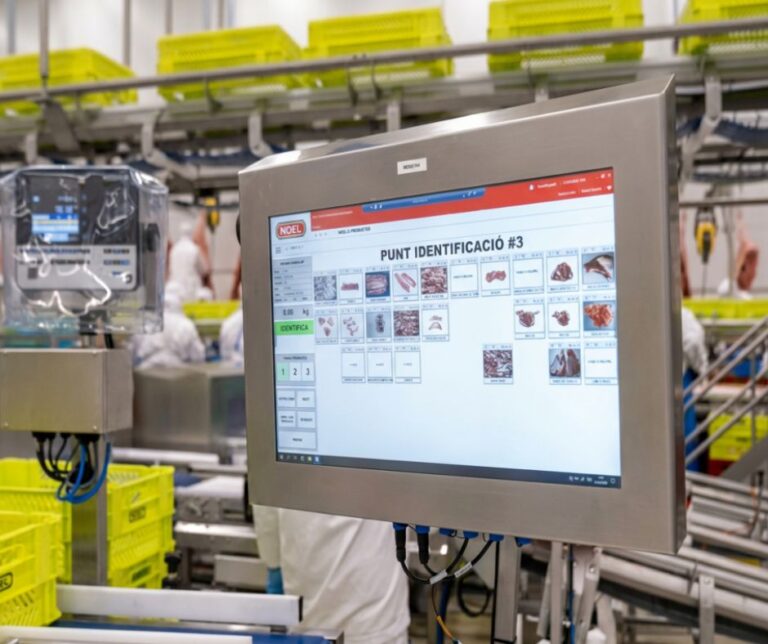
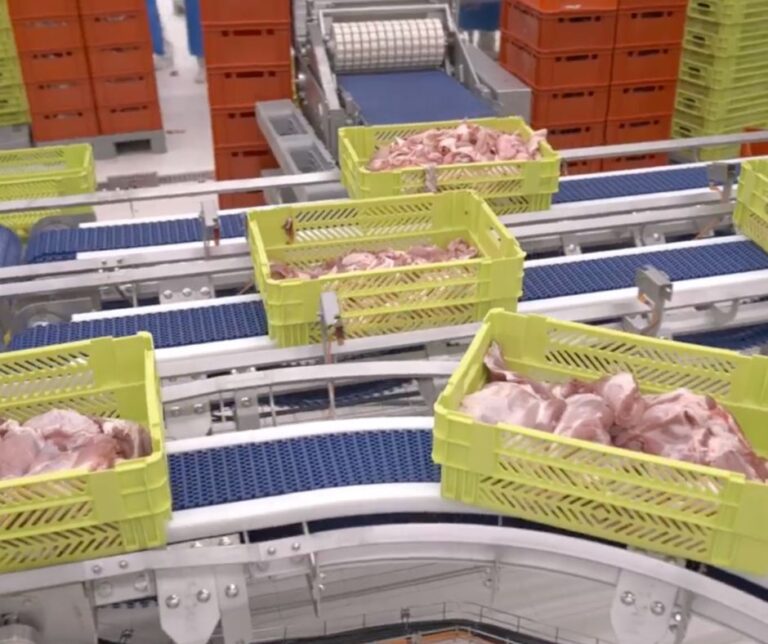
In practice, this means integrating the metal detector into the same section where each box is already identified, its batch verified, and directed to its logistical exit. If the detector operates as an isolated machine, disconnected from the automatic box sorting system and automatic labeling, each rejection requires manual intervention that disrupts the line’s rhythm. Integrated, however, the system itself automatically diverts the rejected box to a separate exit without stopping the rest of the flow.
Verification and Calibration: What Private Regulations Require
In addition to HACCP, most large distributors require compliance with private food safety standards—mainly IFS Food and BRC Food—which detail how the metal detector must be verified:
| Element | Typical Frequency |
|---|---|
| Test with reference spheres (ferrous, non-ferrous, stainless steel) | At the beginning and end of each shift, and with each product change |
| Certified calibration by an accredited technician | At least once a year |
| Retention of verification records | Minimum 12 months (IFS/BRC) |
Each verification with test spheres must be recorded: if the detector does not reject the reference sphere, the line must be stopped and the product manufactured since the last correct verification must be reviewed. This record is also one of the first documents requested by an IFS or BRC auditor.
Integration with the Rest of the End-of-Line
At BLASAU, we integrate metal detection within the same process of identification, box sorting, and labeling, so that the result of the quality control is linked to the traceability record of each box: if a box is rejected, the system reflects it at the same moment it would have generated its label and assigned its destination.
This integration is what differentiates a metal detector installed as isolated equipment from one that truly forms part of the end-of-line: it is not just about detection, but about connecting that detection with everything the system already knows about that box.
Frequently Asked Questions about Metal Detection in the Meat Industry
Can stainless steel pass through a metal detector without being detected?
Stainless steel is the most difficult material to detect due to its low conductivity, but current detectors are specifically calibrated to identify it, as it is the most common material in blades and machinery parts that can fragment. Sensitivity is adjusted according to the particle size to be guaranteed.
Where should the metal detector be placed in a meat processing line?
As close as possible to the end of the process, integrated into the same section where each box is identified and sorted, to minimize the risk of post-inspection contamination.
What happens if the detector rejects a product?
The system automatically diverts the box or piece to a separate exit for manual inspection, without stopping the rest of the line. The incident must be recorded as part of the critical point control.
How often should a metal detector be verified?
At a minimum, at the beginning and end of each shift, and whenever the product changes, using ferrous, non-ferrous, and stainless steel test spheres. Certified calibration by a technician must be performed at least once a year.
Is a metal detector mandatory in a slaughterhouse or cutting plant?
HACCP regulations do not require specific equipment, but if the hazard analysis identifies the risk of metallic contamination as significant—which is common in any plant with cutting machinery—detection becomes a mandatory critical control point.
Do you want to integrate quality control into your end-of-line?
BLASAU S.L. designs and integrates end-of-line systems where metal detection, box sorting, and automatic labeling function as a single process, adapted to the production of each meat processing plant.
See automatic box sorting with traceability →
See automatic labeling and batch traceability →
Contact BLASAU →
About BLASAU S.L.
BLASAU S.L. is a Spanish manufacturer of machinery for the meat industry with over 45 years of experience (since 1977), specializing in slaughter lines, overhead rail systems, and cutting plants for beef, pork, and lamb. With 3,400 m² facilities in Sant Feliu de Pallerols (Girona), it is a European benchmark and has been exporting to France and other European markets since 2010. Its unique specialty is the design of ritual slaughter systems with animal welfare, featuring the Revolver Box for Sheep as a unique product in the kosher slaughter market.