Overhead Rail Systems for Abattoirs: Types, Components, and How to Choose the Right System

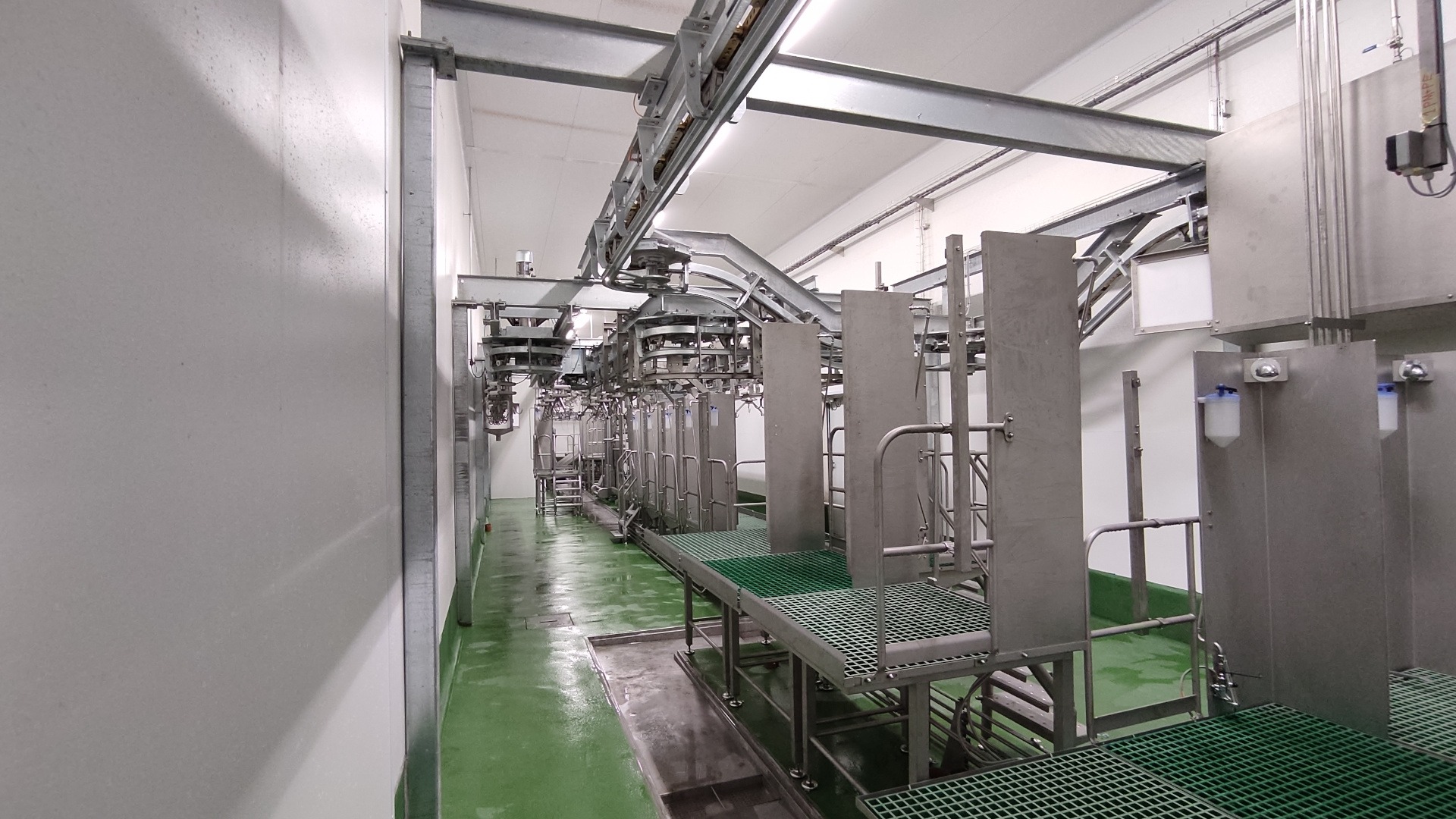
The overhead rail is the most important suspended transport system in any modern abattoir: it allows meat carcasses to be moved along the entire slaughter line without touching the ground. Installing a correctly sized abattoir overhead rail makes the difference between an efficient slaughter chain and costly bottlenecks. There are two main types: the bi-rail system —double flat profile, ideal for heavy cattle— and the tubular rail —round stainless steel tube, preferred for pigs and sheep due to its ease of cleaning. Both comply with EC Regulation 853/2004 on hygiene in the production of food of animal origin.
What is the purpose of an overhead rail in an abattoir?
From the moment of hoisting after bleeding until entering the chilling room, the carcass travels tens of meters, passing through processing, evisceration, veterinary inspection, and classification stations. The overhead rail is the infrastructure that makes this journey possible in a hygienic and continuous manner.
Without a suspended system, manual carcass transport slows down the chain, increases cost per carcass, and multiplies the risk of cross-contamination. EC Regulation 852/2004 also requires that equipment be installed in a way that allows for effective cleaning of the surrounding area — a requirement that the overhead rail meets by design.
The two types of overhead rail for abattoirs: bi-rail and tubular
| Feature | Bi-rail System | Tubular Rail |
|---|---|---|
| Profile | Double parallel flat profile | Round tube |
| Load capacity | High — up to 450 kg per trolley | Medium — pigs and sheep |
| Cleaning and disinfection | Good | Excellent (no angles or edges) |
| Recommended species | Cattle | Pigs, sheep |
| Layout flexibility | Good with switches and points | Very high |
| EU Regulations | ✓ EC 853/2004 | ✓ EC 853/2004 |
The choice of overhead rail type primarily depends on the carcass weight and cleaning requirements. The bi-rail is the most robust option for larger cattle; the tubular is the most hygienic and agile for high-speed pig or sheep lines.
Components
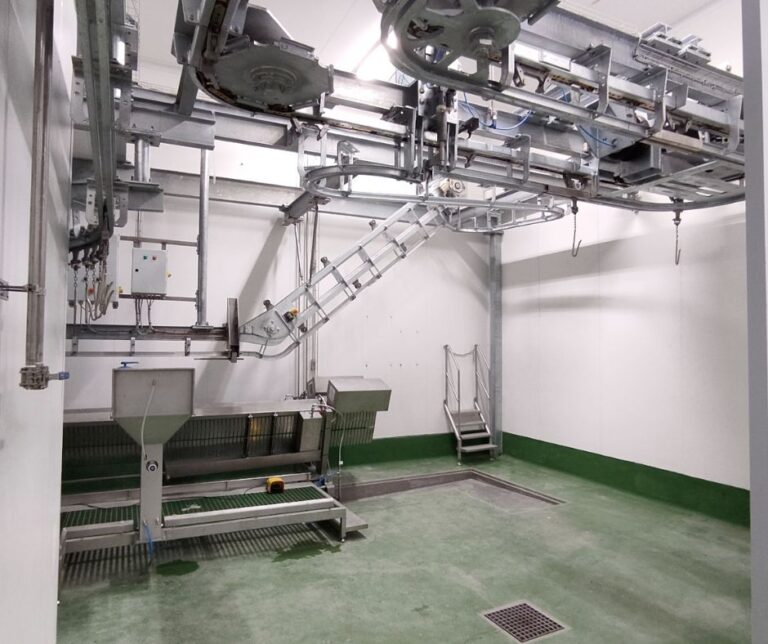
A complete abattoir overhead rail system includes:
- Linear meter (bi-rail or tubular): the standard straight section
- Saddles and support structure: fix the rail to the ceiling or walls
- Curves and switches: change direction and branch the chain
- Points: movable elements that redirect the trolley to one track or another
- Descenders: inclined sections for changes in elevation between stations
- Loading dock telescopic section: connects the internal rail with the truck dock, absorbing level differences
- Hinges and manual stops: allow sections of the rail to be opened and trolleys to be stopped at specific points
- Trolleys: roll on the rail and support the hook with the carcass. There are trolleys for bi-rail and trolleys for tubular rail, all in stainless steel with sealed bearings that do not require lubrication
In mixed installations, the bi-rail/tubular coupling allows trolleys to be transferred from one type of rail to the other without interrupting the chain.
Regulations governing overhead rails in the EU
Three European regulations set the technical and hygienic requirements:
- EC Regulation 853/2004: requires surfaces resistant to corrosion, non-absorbent, and easily washable. AISI 304 stainless steel —the standard material for all BLASAU rail systems— meets this requirement.
- EC Regulation 852/2004: establishes general hygiene principles, including equipment design and maintenance.
- EC Regulation 1099/2009: regulates animal welfare during slaughter, with requirements for hoisting and restraint systems integrated with the rail system.
In Spain, Royal Decree 731/2007 complements these regulations with specific conditions for national abattoirs.
Overhead rail installations completed
BLASAU has been manufacturing and installing overhead rail systems for abattoirs since 1995. Some completed projects:
- La Catalane d’Abattage (Perpignan, France, 2014-2015): manufacturing and installation of overhead rails and machinery in a complete abattoir
- Guasch & Fils (Perpignan, France, 2015): overhead rails in a cutting room
- Noel (2021) and Frivall (2019): pig cutting rooms with complete rail systems
- Matadero de Reinosa (Cantabria, 2009-2010) and Matadero de Potes (Cantabria, 2008-2009): complete cattle, pig, and sheep slaughter lines
- Farma Elassonas (Greece, 2022): expansion of a sheep abattoir with a bleeding and processing line
Installations in Spain, France, Greece, French Guiana, and Venezuela, among other countries.
Frequently Asked Questions
Can an overhead rail system be installed in an existing abattoir without major construction?
In most cases, yes. BLASAU has carried out numerous rail system renovations and expansions in operational abattoirs, utilizing existing structures and coordinating work with scheduled production shutdowns.
What maintenance does the overhead rail require?
A monthly visual inspection of the trolleys and an annual technical review are recommended. The most worn component is the trolley bearings: in high-intensity installations, they may require replacement every 2-3 years. Detecting them in time prevents unscheduled shutdowns in the slaughter chain.
How long does it take to install a complete system?
A simple line for sheep can be installed in 3-5 days. A mixed abattoir with multiple switches and chilling rooms can require between 4 and 8 weeks. BLASAU manages turnkey installation, including commissioning and training for maintenance personnel.
Do you have an overhead rail project?
BLASAU S.L. designs, manufactures, and installs overhead rail systems since 1977. Our technical team prepares proposals adapted to each installation: layout plan, component list, and detailed budget, without obligation.