Automatic labelling and batch traceability in the meat industry: what does the legislation require?

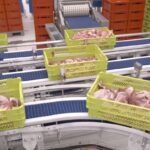
Automatic labelling is the process of applying, to each box or meat cut, the batch, date and origin information required by food legislation, without manual intervention. Batch traceability is the ability to reconstruct, from that label, the product’s entire journey from the source animal to the dispatch point. In a plant with automatic box sorting, both processes must be synchronised: the label is generated at the exact moment the system identifies and sorts each box.
Why labelling and traceability cannot be handled separately
When a plant sorts boxes automatically, each box already has a batch identification associated with it in the system. If physical labelling is done in a separate step—manual, or on a machine not synchronised with the sorting—there is a real risk: a label that does not match the batch the box actually contains.
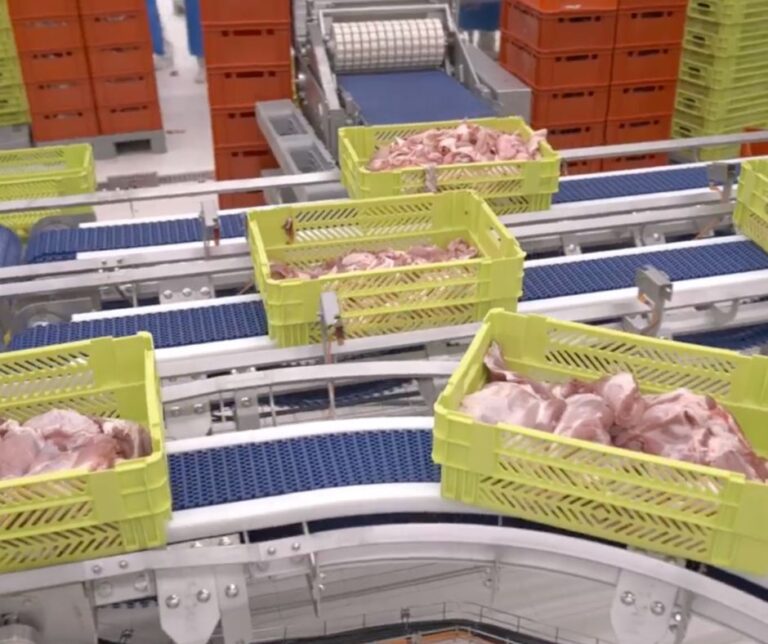
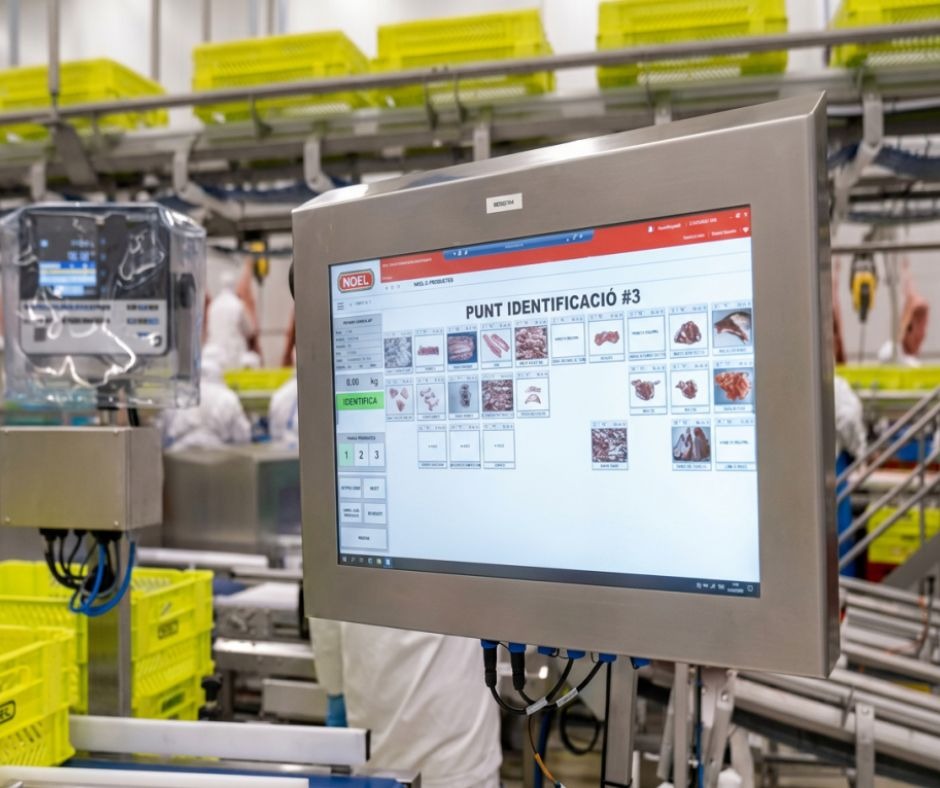
That is why, in a well-designed end of line, automatic labelling is not a standalone machine: it is one more function within the same system that identifies, verifies quality control and routes each box to its destination. The label is printed with the data the system has already recorded at that moment, and that same record is what later makes it possible to respond to a complaint or an inspection in minutes instead of days.
What information must appear on a meat product label
Not all information is mandatory for all products, but this is what European legislation generally requires:
| Label item | Mandatory | Legislation requiring it |
|---|---|---|
| Name of the food | Yes | Regulation (EU) 1169/2011 |
| Batch number or reference | Yes | Directive 2011/91/EU + Regulation (EU) 931/2011 |
| Date of minimum durability or use-by date | Yes | Regulation (EU) 1169/2011 |
| Net quantity | Yes | Regulation (EU) 1169/2011 |
| Name and address of the responsible operator | Yes | Regulation (EU) 1169/2011 |
| Country of origin / slaughter | Yes (beef, and extended to pork/sheep/poultry) | Royal Decree 1698/2003 (beef) + Regulation (EU) 1337/2013 |
| Storage conditions | Yes | Regulation (EU) 1169/2011 |
| Internal traceability code (QR, DataMatrix, RFID) | Optional, but increasingly required by major retailers | — |
The batch reference is the data point that connects the physical label with the digital traceability record: without it, all the information the system captured during automatic sorting has no way to be linked to the physical product.
Automatic labelling technologies at the end of line
In a meat plant, automatic labelling is mainly implemented using three types of technology, which are often combined:
- Print & apply: prints the label on demand (with variable batch, date and weight) and applies it directly to the box via an applicator head, without stopping the line.
- Weight-price labelling: integrates an approved scale that calculates the price based on the actual weight of each piece and prints it along with the rest of the mandatory data.
- Traceability codes (QR / DataMatrix / RFID): in addition to readable text, they include a code that allows the entire batch history—origin, slaughter date, quality checks passed—to be consulted digitally with a simple scan.
The key technical point is not the labeller itself, but its synchronisation with the rest of the end of line: the box identification, the quality control result (for example, passing through a metal detector) and the destination assigned by the sorting system must be reflected on the same label, at the same moment.
EU and Spanish legislation on traceability and meat labelling
Traceability and meat labelling are based on four legal texts that every plant should know:
- Regulation (EC) 178/2002: sets out the general principles of food law and requires all operators to have systems to identify from whom they receive and to whom they supply each product—the “one step back, one step forward” traceability.
- Commission Implementing Regulation (EU) 931/2011: develops 178/2002 specifically for food of animal origin. It requires recording, for each dispatch, the nature of the product, the quantity, the name and address of the supplier, the batch reference and the dispatch date.
- Regulation (EU) 1169/2011: regulates food information provided to the consumer—name, batch, date, net quantity, storage conditions and the operator responsible for the product.
- Royal Decree 1698/2003: Spanish legislation specific to the labelling of beef (including minced), which adds the obligation to indicate the animal’s category, sex and country of slaughter.
In Spain, according to AESAN guidelines, traceability records for meat products must be kept for a minimum of five years.
How labelling is integrated into an automated end of line
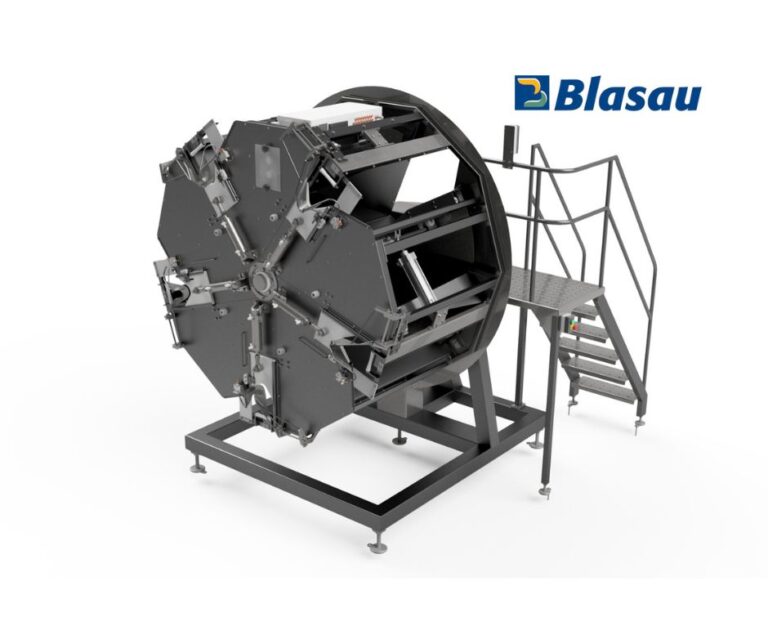
At BLASAU we design end-of-line systems where product identification, quality control, box sorting and labelling form a single automated process: the box is identified, verified, sorted to its output and labelled with the corresponding batch data, all within the same flow and without intermediate manual operations.
This integration is what turns a simple labeller into a true traceability solution: it is not enough to print a label—you must ensure that the data on it is exactly what the system has recorded for that box at that moment.
Frequently asked questions about automatic labelling and batch traceability
Is automatic labelling mandatory in a meat plant?
No. The law does not require labelling to be automatic, but it does require the mandatory information (batch, date, origin, quantity) to appear correctly on each product. Beyond a certain production volume, manual labelling is no longer reliable for ensuring that accuracy, so automation becomes the practical way to comply with the legislation without errors.
What is the difference between traceability and labelling?
Traceability is the ability to reconstruct a product’s complete journey through data records at each stage of the process. Labelling is the physical—or digital, via a code—means that makes that information visible on the product. A traceability system without correct labelling is useless at the dispatch point.
How long must batch traceability records be kept?
In Spain, AESAN’s usual reference is a minimum of five years for meat products, although the exact period may vary depending on the type of product and its shelf life.
Can automatic labelling be integrated with an existing box sorting system?
Yes. Integration is precisely what adds value: synchronising the labeller with the existing identification and sorting system so that each label reflects the box’s real data at the moment it leaves. BLASAU assesses each existing installation to define the optimal integration point.
What happens if the label and the traceability record do not match?
This is the scenario automation aims to prevent: a discrepancy between what the label says and what the system records can lead to a slower, more costly product recall in the event of an incident, as well as non-compliance with Regulation 931/2011.
Would you like to integrate automatic labelling into your end of line?
BLASAU S.L. designs and integrates product identification, quality control, box sorting and automatic labelling systems into a single end-of-line process, tailored to each meat plant’s production.
See automatic box sorting with traceability →
See BLASAU solutions →
Contact BLASAU →