Slaughter lines for abattoirs: cattle, pork and sheep — complete technical guide
Everything about industrial slaughter lines for cattle, pork and sheep. Process stages, required machinery, regulations and design criteria. By BLASAU S.L.

By BLASAU S.L. — manufacturer of machinery for the meat industry since 1977.
An abattoir slaughter line is the set of machinery, infrastructure and transport systems that make up the hygienic animal slaughter process, from stunning through to obtaining the carcass ready for marketing. Lines are designed specifically for each species—cattle, pigs or sheep—with significant differences in capacity, machinery and regulatory requirements.
Stages of a slaughter line
Regardless of species, every slaughter line follows an equivalent sequence of stages: pre-slaughter animal handling in lairage and pens, stunning and slaughter, bleeding and hoisting via overhead rail, dressing and transfer, skinning or scalding and dehairing depending on the species, evisceration and carcass splitting, and finally chilling before transfer to the cutting room.
What changes between species is not the sequence, but the machinery required at each stage, the line speed, and the type of stunning and restraint. The following table summarises the main differences:
Comparison of slaughter lines by species
| Feature | Cattle line | Pork line | Sheep line |
|---|---|---|---|
| Average carcass weight | 200–350 kg | 70–100 kg | 15–30 kg |
| Typical capacity | 20–120 head/hour | 100–600 pigs/hour | 100–400 sheep/hour |
| Stunning | Electrical stunning box or captive-bolt gun | CO&sub2; or electrical box | Revolver box / restrainer |
| Scalding and dehairing | No | Yes, scalding tank and automatic dehairer | No |
| Skinning | Rotary knife, dehorners | Not applicable | Species-specific skinning systems |
| Dressing platforms | Pneumatic elevating platforms (3–5 levels) | Fixed or elevating | Fixed |
| Ritual slaughter | Ritual box (halal/kosher) | Halal boxes | Sheep Revolver Box (kosher) |
Cattle slaughter line
The cattle line handles the highest carcass weight of the three species, which requires an overhead rail and structure sized for loads of up to 450 kg per trolley. The process incorporates an electrical stunning box or captive-bolt gun, hoisting and bleeding systems, pneumatic dressing platforms that adjust in height to each operator—typically between 3 and 5 levels—and skinning systems using a rotary knife and dehorners. When the plant performs ritual slaughter, a dedicated ritual box for halal or kosher is integrated.
Pork slaughter line
The pork line has the highest hourly capacity of the three, with restrainers that immobilise the animal for stunning—typically by CO&sub2; or electrically—before bleeding. Unlike cattle and sheep, pigs are not skinned: they pass through a scalding tank and an automatic dehairer that removes hair from the skin, which is retained as part of the carcass. Dressing systems are usually fixed or use elevating platforms depending on the plant’s throughput.
Sheep slaughter line
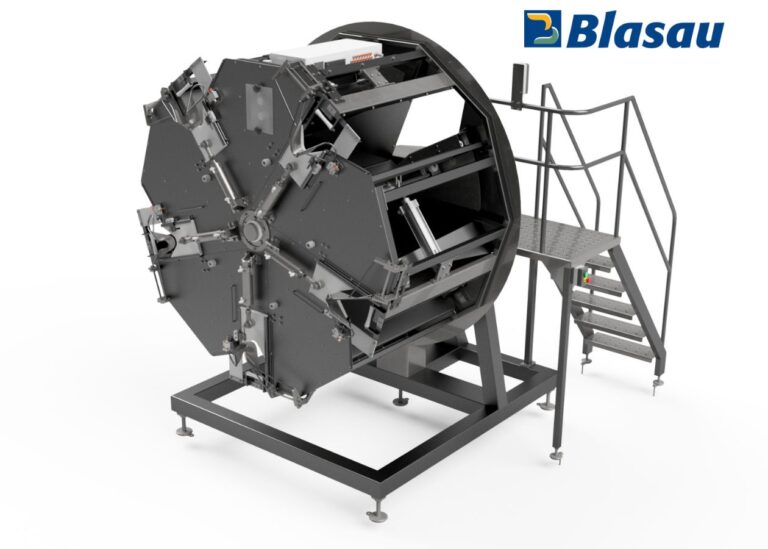
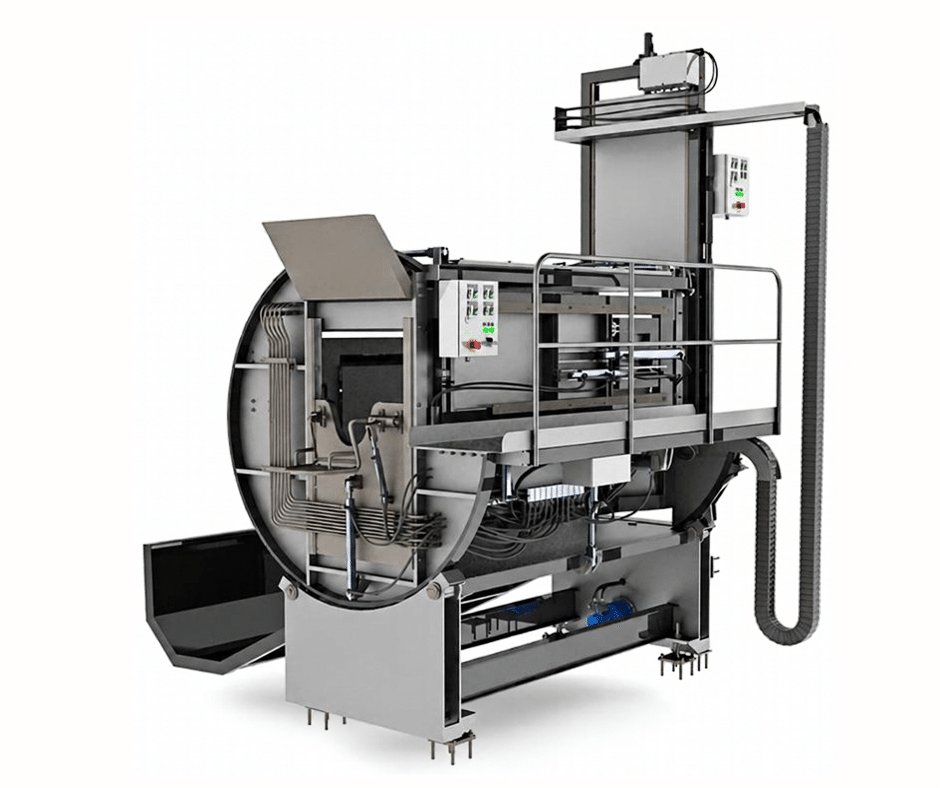
The sheep line handles much lighter carcasses, enabling more compact installations without reducing regulatory requirements. It includes sheep-specific restrainers, bleeding and hoisting systems, and species-specific skinning systems. For ritual slaughter, BLASAU manufactures the Sheep Revolver Box (model LM205C5): a five-compartment rotary system that turns the animal into a dorsal position before the cut, meeting kosher (shechita) slaughter requirements alongside the animal welfare requirements of EC Regulation 1099/2009.
Regulations applicable to slaughter lines in Spain
Any slaughter line in Spain and the EU must comply with three regulatory frameworks: EC Regulation 1099/2009 on the protection of animals at the time of killing; EC Regulation 853/2004 on the hygiene of food of animal origin; and Royal Decree 731/2007, which sets out the specific conditions for abattoirs in Spain. All BLASAU machinery is designed to comply with this regulatory framework from the initial project stage.
How much does a complete slaughter line cost?
The cost of a slaughter line depends on the species, hourly capacity and degree of automation, and ranges from compact installations for low-volume abattoirs to high-capacity industrial lines with pneumatic platforms and integrated ritual systems. Given the number of variables—species, capacity, required civil works and level of automation—the quotation is always prepared on a bespoke basis after assessing the specific project.
BLASAU: turnkey design and installation since 1977
BLASAU S.L. has been designing and installing slaughter lines in Spain and Europe for more than 45 years—since 1977. With 3,400 m² facilities in Sant Feliu de Pallerols (Girona), the company has been exporting to France and other European countries since 2010. It is a second-generation family business, and the Sheep Revolver Box LM205C5 is its unique differentiating product in the kosher sheep slaughter market.
Frequently asked questions about slaughter lines
Which regulations govern slaughter lines in the EU?
EC Regulation 1099/2009 sets out animal welfare requirements during slaughter. EC Regulation 853/2004 governs the hygiene of products of animal origin. In Spain, Royal Decree 731/2007 sets out the specific conditions for abattoirs. All BLASAU machinery complies with these regulations.
What is the difference between a cattle slaughter line and a pork slaughter line?
The main differences are the animal weight (200–350 kg for cattle versus 70–100 kg for pigs), the dressing process—pork includes scalding and dehairing instead of skinning—the line speed, and the type of work platforms required.
Can a slaughter line be installed that complies with halal and kosher slaughter?
Yes. BLASAU manufactures ritual boxes for slaughter without prior stunning, for both cattle and sheep. The Sheep Revolver Box is a system specifically designed for kosher sheep slaughter that preserves animal welfare throughout the process.
How long does it take to install a complete slaughter line?
Depending on the scale and complexity, a complete installation can take between 3 and 12 months, including manufacturing, civil works and commissioning. BLASAU manages the entire project on a turnkey basis.
If you are assessing a slaughter line project for cattle, pigs or sheep, at BLASAU we design and install the complete solution, including ritual slaughter. Contact our technical team to assess your project.
About BLASAU S.L.
BLASAU S.L. is a Spanish manufacturer of machinery for the meat industry with over 45 years of experience (since 1977), specializing in slaughter lines, overhead rail systems, and cutting plants for beef, pork, and lamb. With 3,400 m² facilities in Sant Feliu de Pallerols (Girona), it is a European benchmark and has been exporting to France and other European markets since 2010. Its unique specialty is the design of ritual slaughter systems with animal welfare, featuring the Revolver Box for Sheep as a unique product in the kosher slaughter market.