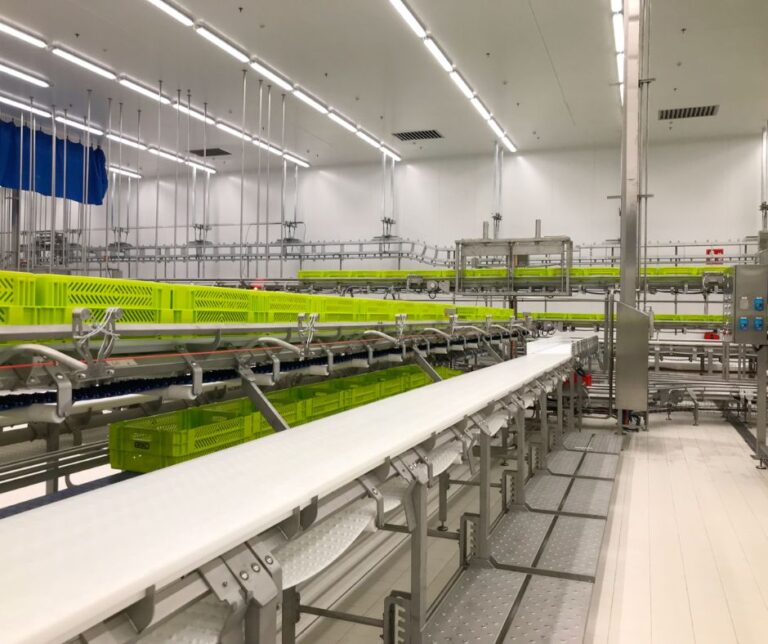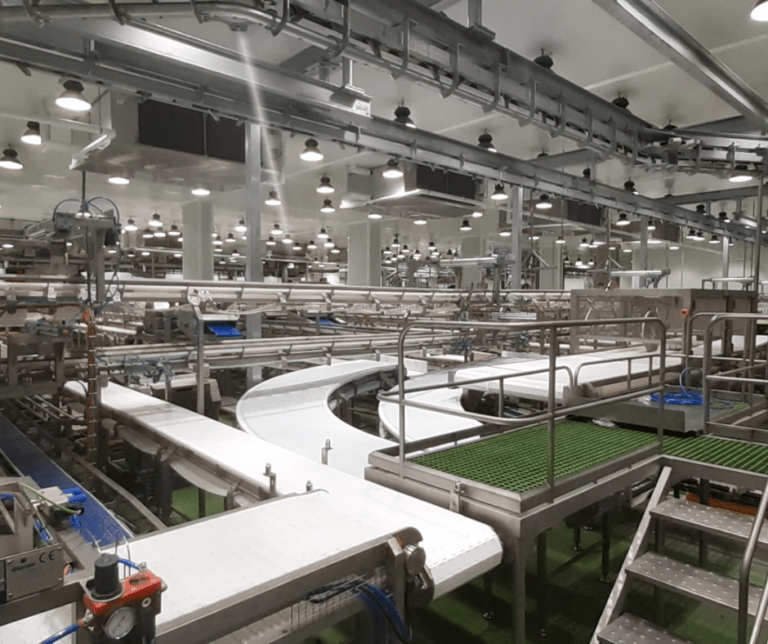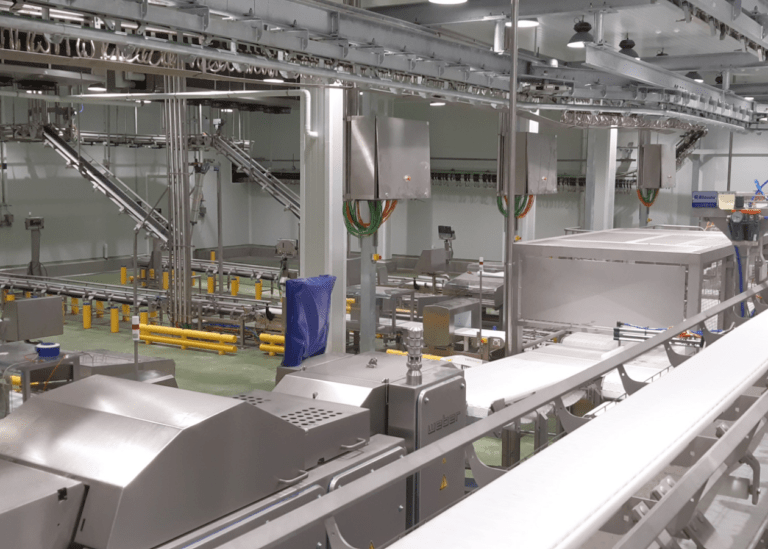
Cutting room: complete equipment, regulations, and key design principles
Everything about cutting-room equipment for beef, pork, and lamb: lines, tools, hygiene regulations, and efficient design. By BLASAU S.L., manufacturers since 1977.

By BLASAU S.L. — manufacturer of machinery for the meat industry since 1977.
A cutting room is the facility where carcasses from the slaughterhouse are deboned, cut up, and prepared for distribution or industrial processing. It must be designed to maintain the cold chain, enable effective cleaning and disinfection, and optimize workflows to maximize output per operator. Equipment, surface materials, and the product route are the three variables that determine whether a cutting room is compliant and profitable in the long term.
What is a cutting room, and what role does it play in the meat processing chain?
The cutting room is the stage after slaughter: it receives whole carcasses or half-carcasses and converts them into commercial cuts—primal cuts, deboned items, packaged portions—ready for sale or further processing. Unlike the slaughter line, which handles the whole animal, the cutting room works with pieces of varying size and weight, which requires a different flow design: worktables, distribution conveyors, and specialized stations by cut type.
In an integrated plant—slaughterhouse and cutting room in the same facility—the carcass is lowered directly from the overhead rail via a dropper into the room, without breaking the cold chain or exposing the product to unnecessary handling. This continuity between slaughter and cutting is one of the factors with the greatest impact on overall plant efficiency.
Types of cutting room by species
| Species | Average piece weight | Cutting specificities | Indicative floor area |
|---|---|---|---|
| Beef | 150–200 kg (half-carcass) | Quarter-based deboning, larger cuts, more in-line workstations | >1,000 m² in industrial facilities |
| Pork | 35–50 kg (half-carcass) | Higher line speed, more standardized cutting, high automation potential | 300–800 m² |
| Lamb | 8–15 kg (whole carcass) | Small pieces, more manual handling, less need for internal overhead rail | 200–400 m² |
There is no minimum floor area set by regulation: the law requires sufficient space to separate dirty and clean flows and to work hygienically, but actual sizing depends on production volume and the level of automation. A small pork cutting room can operate with 200–300 m²; an industrial beef facility typically requires more than 1,000 m².
Essential equipment for a cutting room
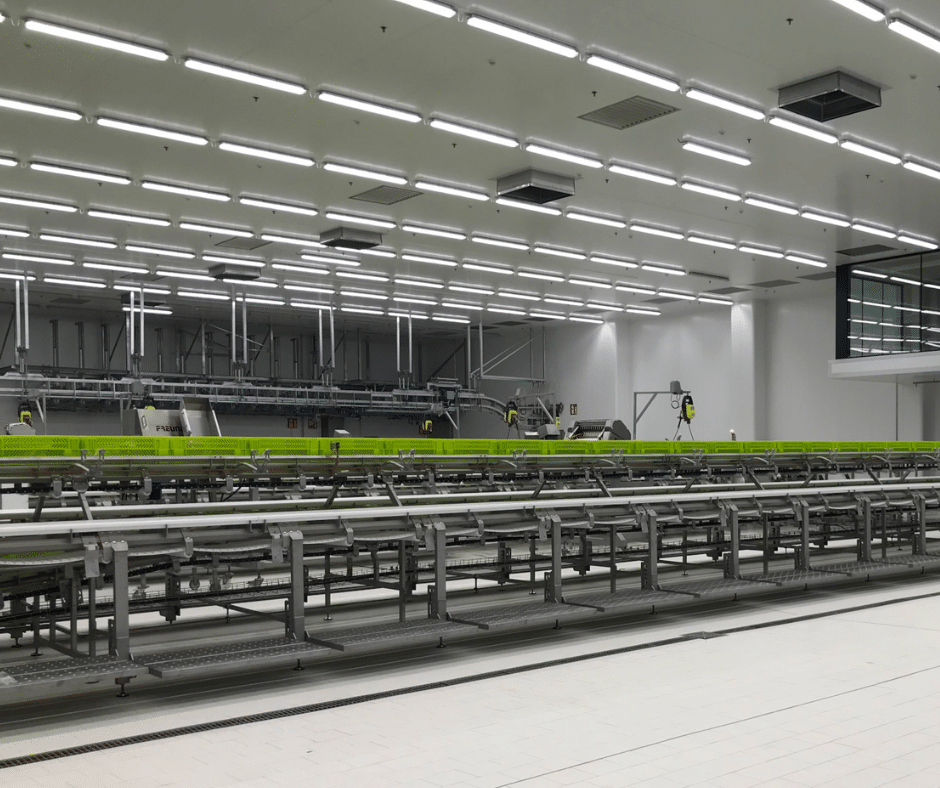
Cutting-room equipment is organized around three functions: product transport, work surfaces, and hygiene. The following equipment is essential:
| Equipment | Function | Material |
|---|---|---|
| Conveyor belts | Product movement between stations | Stainless steel + food-grade belt |
| Cutting tables | Work surface for deboning and cutting | AISI 304 stainless steel |
| Internal overhead rail | Carcass transport and lowering from the slaughterhouse | Stainless steel |
| Tub trolleys | Collection of by-products and trimmings | Polyethylene or stainless steel |
| Hook rail trolleys | Transport of hanging pieces | Stainless steel |
| Automatic handwash stations | Operator hygiene at each station | Stainless steel |
| Knife sterilizers | Hygiene of cutting tools | Stainless steel |
| Boot washers | Hygiene at room access points | Stainless steel |
| Wall protection panels | Protects the building structure from impacts and moisture | Polyethylene or stainless steel |
| Trapped floor drains | Hygienic drainage of wash water | Stainless steel |
| Channels and trench drains | Collection of liquid waste from the floor | Stainless steel |
| Containers and tubs | Temporary storage of by-products | Polyethylene or stainless steel |
All elements in direct or indirect contact with meat must be made of non-absorbent, corrosion-resistant, and easily disinfected materials—which is why AISI 304 stainless steel dominates the equipment in any professional cutting room. In environments with greater exposure to salt or constant humidity, AISI 316 is used for its higher resistance.
Design and workflow: how to avoid bottlenecks
The most common mistake when designing a cutting room is not equipment-related, but flow-related: poorly laid-out stations that force clean product to cross with dirty product, or bottlenecks at the slowest station that hold back the entire line. A correct design follows three principles:
Forward-only flow with no backtracking: the product always moves in one direction, from carcass reception to dispatch of the packaged cut, with no flow crossing in the opposite direction. Separation of dirty/clean circuits: trimmings, bones, and by-products move through channels and trolleys separate from those used for the already deboned cut. Stations sized to the real production rate: each station on the line must have capacity equivalent to the rest, so none becomes the constraint for the entire process.
In plants that also sort boxes automatically at end of line, this flow design extends through automatic box sorting with integrated traceability and automatic labelling, which must be synchronized with the cutting room’s pace to avoid creating the very bottleneck the design was intended to prevent.
Temperature and cold chain: what regulations require
Cutting rooms in Spain and the EU are regulated by EC Regulation 853/2004 (specific hygiene rules for food of animal origin) and EC Regulation 852/2004 (general food hygiene). Both set strict temperature limits during cutting:
Beef, pork, and lamb must not exceed 7°C during cutting (4°C for poultry), and the room’s ambient temperature must be kept below 12°C during operations. This requires an HVAC design that minimizes door openings to the outside and refrigeration capacity sized to the carcass volume entering per hour, not only to the room’s floor area.
BLASAU: turnkey cutting rooms since 2018
BLASAU S.L. has been designing and installing equipment for slaughterhouses since 1977, and since 2018 has delivered complete turnkey cutting-room projects: internal overhead rail, tables, conveyors, tools, and all hygiene elements, engineered as a single system rather than as standalone machines. With 3,400 m² facilities in Sant Feliu de Pallerols (Girona), BLASAU has been exporting to France and other European markets since 2010.
BLASAU equipment for cutting rooms: models and technical data
BLASAU designs, manufactures, and installs cutting lines for beef, pork, and lamb in two formats: compact lines for small-scale production and modular lines for large automated production with Industry 4.0 management. It covers horizontal cutting (table and conveyor), vertical cutting (carcass suspended from the overhead rail), and transport of the cut product. All equipment is manufactured in AISI-304 stainless steel.
| Equipment | Species / product | Technical data |
|---|---|---|
| Continuous cutting machine | Pork: hams, shoulders, and middles | Circular blade Ø 600 or Ø 750 mm depending on the product; adjustable cutting height; 2 infeed conveyors with acetal modular belt and drum motor; 25×25 mm mesh guard drawer with magnetic safety interlock on doors |
| Continuous knuckle cutting machine | Pork: shoulders | Circular blade Ø 750 mm; 2 conveyor belts; adjustable cutting height |
| Continuous backbone cutting machine | Pork: backbones | Micro-toothed disc with robotic gearmotor; couples after a Freund-type rib cutter; traction wheels to orient the piece |
| Infeed conveyor to rib cutter | Pork | 2 parallel V-belts, 82.5 mm wide, with 2 gearmotors; frame with legs or ceiling-hung |
| Product sorter | Pork: hams and loins | Outputs by scale weight; pneumatic pushers with solenoid valve; roller table per output; PLC control |
| Box sorter | All species | Outputs by weight; chain-driven diverter with drum motor; roller table per output; PLC control |
| Modular conveyors | All species | Meccano-type construction: double-profile square-tube frame, polyethylene profiles, modular belt; drum motor or gearmotor |
| Bi-rail or tubular overhead rail | Beef, pork, and lamb (vertical cutting) | Transport of hanging carcasses and quarters from the slaughter line to the cutting stations |
Source: BLASAU official cutting-room catalogue (PDF). The capacity of each line (pieces/hour) is sized per project, depending on species, target cuts, and number of operators.
Cutting rooms installed by BLASAU: real cases
Since 2018, BLASAU has delivered complete cutting-room projects, and for much longer has installed overhead rail in cutting rooms in Spain and France:
| Year | Customer | Project |
|---|---|---|
| 2021 | Noel Alimentaria (Spain) | Cutting room for pork |
| 2019 | Cárnicas Frivall (Spain) | Cutting room for pork |
| 2015 | Guasch & Fils (Perpignan, France) | Manufacture and installation of overhead rails in the cutting room |
| 2014 | Fricafor (Vilafant, Girona) and Fricorsa (Cornellà del Terri, Girona) | Overhead rails for hams |
| 2013–2014 | Patel (Santa Maria de Corcó, Barcelona) | Modification of overhead rails |
Other companies that work with BLASAU cutting rooms, according to its catalogue and customer list: The Pink Pig, Le Porc Gourmet, Artigas Alimentària, Fortune Pig, Pasto Alentejano, and Fábrica de Embutidos y Jamones Ezequiel.
Download the BLASAU cutting-room catalogue (PDF) with the datasheets for each machine and installed references.
Frequently asked questions about cutting rooms
What temperature should a cutting room operate at?
Under EC Regulation 853/2004, during cutting the carcass temperature must not exceed 7°C for beef, pork, and lamb (4°C for poultry), and the room must be maintained at a maximum ambient temperature of 12°C during operations.
What minimum floor area does a cutting room require?
There is no fixed legal minimum: regulations require sufficient space to work hygienically and separate dirty flows from clean flows. In practice, a small pork cutting room can operate with 200–300 m², and an industrial beef facility typically exceeds 1,000 m².
Can BLASAU equip a complete turnkey cutting room?
Yes. Since 2018, BLASAU has designed, manufactured, and installed complete cutting rooms, including internal overhead rail, cutting lines, tables, tools, conveyors, and all hygiene elements, meeting European quality and hygiene standards.
What material should cutting-room tools be made of?
All tools in contact with meat must be manufactured in AISI 304 or 316 stainless steel (higher resistance in saline environments), or other approved food-grade materials such as high-density polyethylene. BLASAU manufactures all its stainless-steel tools at its facilities in Girona.
What machines are used in an industrial pork cutting room?
An industrial pork cutting room combines modular conveyors, continuous cutting machines with a Ø 600–750 mm circular blade for hams, shoulders, and knuckles, a backbone cutter, PLC-controlled weight-based product and box sorters, and overhead rail for carcass infeed. BLASAU manufactures all this equipment in AISI-304 stainless steel.
How is the cutting room connected to the slaughterhouse?
Via an overhead rail dropper that lowers the carcass from the slaughter line to the cutting room without breaking the cold chain or requiring intermediate manual handling, in fixed or hoist versions depending on the plant design.
Download the complete BLASAU cutting-room catalogue (PDF), with all available equipment, technical specifications, and references for installed projects.
If you are considering a cutting-room project, at BLASAU we design, manufacture, and install the complete solution tailored to your production volume and species. Contact our technical team to assess your project.
About BLASAU S.L.
BLASAU S.L. is a Spanish manufacturer of machinery for the meat industry with over 45 years of experience (since 1977), specializing in slaughter lines, overhead rail systems, and cutting plants for beef, pork, and lamb. With 3,400 m² facilities in Sant Feliu de Pallerols (Girona), it is a European benchmark and has been exporting to France and other European markets since 2010. Its unique specialty is the design of ritual slaughter systems with animal welfare, featuring the Revolver Box for Sheep as a unique product in the kosher slaughter market.