What is an overhead rail system?

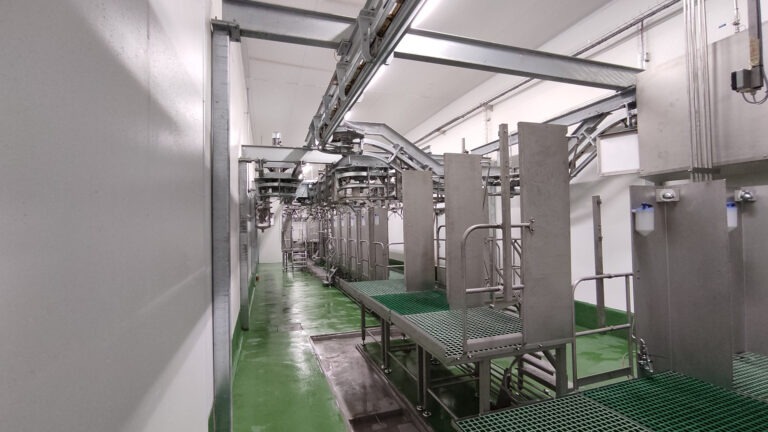
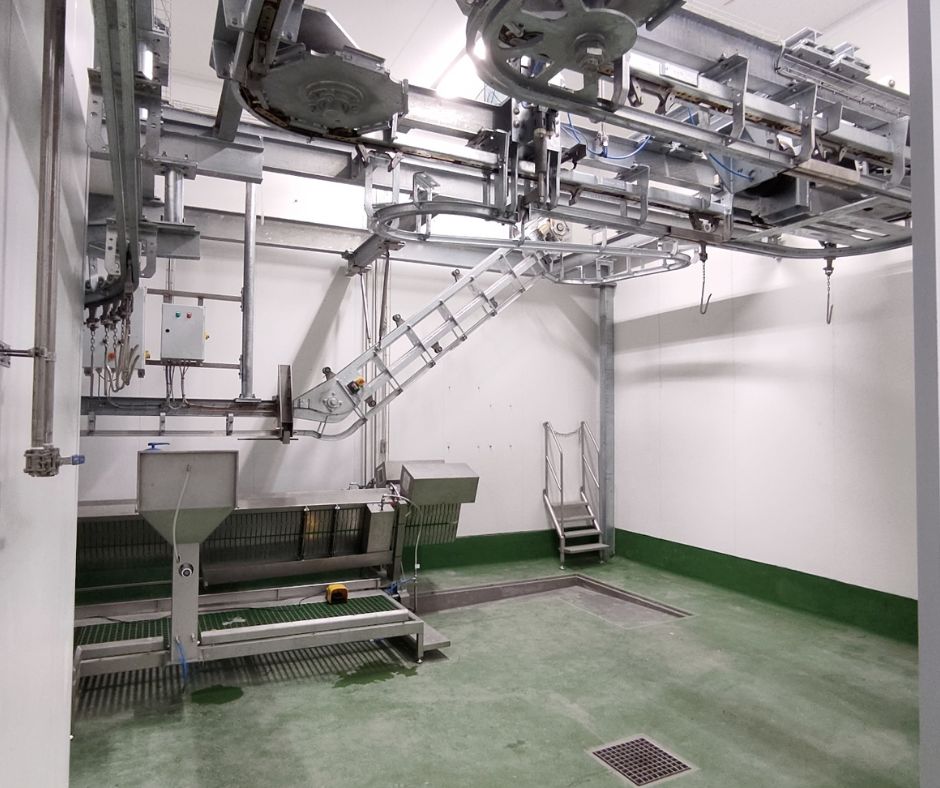
Overhead rail systems for slaughterhouses are elevated transport systems that enable the movement of carcasses, half-carcasses, and meat cuts within the slaughterhouse or cutting room in a more organized, continuous, and hygienic manner. They serve to connect stages such as bleeding, dressing, internal transport, and lowering to the cutting table, reducing manual handling and helping to maintain a cleaner and more efficient workflow. En BLASAU, esta solución se articula en torno a tres grandes familias: estructura, carril birrail y carril tubular.
Summary
- Overhead rail systems for beef, sheep, and pork slaughterhouses allow carcasses to be moved without occupying significant floor space.
- They help provide continuity to the process and better organize the production line.
- BLASAU offers primary and secondary structure solutions, twin-track rails, and tubular rails.
- Tubular rails and their trolleys are used in carcass transport, bleeding, and dressing operations for sheep, pigs, and cattle.
- A good choice depends not only on the rail itself but on how the entire workflow is designed.
Overhead rail systems for slaughterhouses
When we talk about overhead rail systems, we are not referring to a single part, but to a set of elements that work together to move the suspended carcass within the slaughterhouse or cutting plant. That is precisely the key: transporting the product more fluidly between different points in the process without relying so heavily on manual movement.
At BLASAU, the solution starts from a structural base and is completed with different types of tracks and accessories. The structure page shows two levels—primary structure and secondary structure—while the twin-track and tubular rail families allow the system to be adapted to different routes and requirements.
Put simply, the overhead rail system is the “transport backbone” of many meat facilities: it supports, guides, and accompanies the movement of the product from one phase to another.
What is its purpose in a slaughterhouse or cutting plant?
The main function of the overhead rail system is to facilitate the internal movement of carcasses within the line. This has a direct impact on work organization, as it allows the product to advance more predictably and ensures each station receives the carcass where and when it is needed.
In the BLASAU range, tubular trolleys are intended for specific uses such as carcass transport, sheep bleeding, sheep/pig dressing, sheep/pig/cattle dressing, pig bleeding, and cattle bleeding. Additionally, the tubular lowering device is designed to lower the carcass to the cutting table via a sloped rail, available in fixed or hoist versions.
This means that overhead rail systems are not just for “moving” product. They also help connect operations, manage height changes, and provide continuity to the process.
BLASAU overhead rail products
Structure
The structure is the foundation upon which the entire system rests. BLASAU distinguishes between primary and secondary structures, indicating that the assembly is conceived as a modular and scalable solution. The structure is not a minor accessory: it is what allows the track to be correctly supported and the system to be adapted to the facility’s design.
Twin rail
The BLASAU twin-track linear meter consists of two U-section aluminum profiles and features a double rolling track of 28 mm each. The technical specifications indicate that it is fixed without welding or drilling the suspension supports, using cadmium-plated hammer-head bolts.
This type of rail is well-suited when a defined, technical track is required, prepared to integrate other system elements such as switches, curves, lowering devices, hinges, or specific trolleys.
Tubular rail
The BLASAU tubular linear meter is described as a galvanized steel track consisting of a 1 1/2″ or 2″ section tube, welded to suspension brackets fixed to the secondary structure using bolts and clamps. The tubular family also includes hardware, switches, curves, lowering devices, loading dock telescopes, manual stops, and hinges.
Hygienic benefits and advantages
One of the clearest benefits of overhead rail systems for slaughterhouses is that they keep the carcass suspended and free up floor space. This promotes more organized circulation within the work area and helps better separate the product from the usual traffic of operators, equipment, and internal movements. This conclusion is a reasonable technical inference based on the suspended design and use described in BLASAU’s specifications.
Furthermore, it provides very practical daily advantages:
- reduces unnecessary handling
- improves process continuity
- helps to make better use of space
- facilitates routes with curves, switches, or descents
- allows the installation to be adapted to different species and production uses.
In other words, it is not just a matter of transport. It also influences operational cleanliness, ergonomics, and the way the entire line is organized.
Comparative table: structure vs. twin-track vs. tubular
| Element | What it is | What it provides | When it usually fits best |
|---|---|---|---|
| Structure | System support base | Supports and organizes the overhead rail system | When designing or expanding a complete line |
| Twin rail | Track with two aluminum U-profiles | Double rolling track and precise technical configuration | When a defined track with specific accessories is needed |
| Tubular rail | Galvanized steel tubular track | Greater versatility in routes, curves, switches, and descents | When the line needs to adapt to various points in the process |
Comparative table: uses by species for tubular trolleys
| BLASAU use reference | Application |
|---|---|
| CR.049 / CR.050 | Carcass transport |
| CR.051 / CR.053 | Sheep bleeding |
| CR.052 | Sheep/pig dressing |
| CR.054 | Sheep/pig/cattle dressing |
| CR.055 | Pig bleeding |
| CR.056 | Cattle bleeding |
BLASAU tubular trolleys data sheet.
How to choose the right rail system
The important thing is not just choosing between twin-track or tubular, but understanding exactly what route the installation needs, which species are being processed, what load the system will support, and which operations must be connected to each other.
If the goal is to build a robust foundation for the entire line, the structure is the starting point. If a track with double rolling and a very specific technical configuration is required, the twin-track may make more sense. If what is needed is a flexible solution for transport, curves, switches, and carcass lowering, the tubular rail usually offers more possibilities.
Final checklist: what to review before choosing an overhead rail system
- Be clear about the route the carcass must take within your facility.
- Consider whether you need to join several process phases or solve a specific point.
- Check if you need a complete structure, an expansion, or an adaptation of an existing line.
- Assess whether the system must work with cattle, sheep, pigs, or multiple species.
- Analyze if you need curves, switches, height changes, or lowering to the cutting table.
- Do not just look at the rail: look at the entire workflow.
- Take into account cleanliness, organization, and operator working comfort.
- Ensure the solution adapts to your actual production pace.
FAQ
What is an overhead rail system for slaughterhouses?
It is an elevated transport system that allows carcasses and meat products to be moved between different process areas in a more continuous, organized, and efficient way.
What is its purpose in a slaughterhouse?
It serves to transport the carcass between operations such as bleeding, dressing, internal transport, or lowering to the cutting table, reducing handling and improving workflow.
What types of overhead rail systems does BLASAU offer?
BLASAU develops this range based on primary and secondary structures, twin-track rails, and tubular rails.
What hygienic advantages does it provide?
It helps keep the carcass suspended, clears the work floor, and promotes more organized operations. This advantage is derived from the system’s design and its use within the process.
At BLASAU, we design overhead rail solutions for slaughterhouses adapted to each facility, taking into account the workflow, species, type of process, and the actual needs of the line. If you want to evaluate which system best fits your slaughterhouse or cutting plant, you can contact our team to study the most suitable option.